After a tumultuous year, Petke finds peace
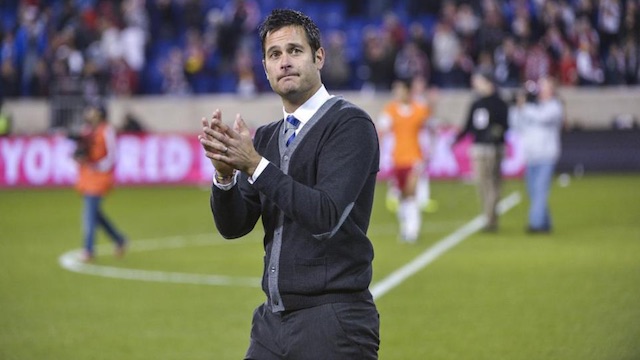
March 17, 2016


By his own admission, 2015 was the strangest year of Mike Petke’s life.
The 12-year MLS veteran had just completed two of the most successful seasons in New York Red Bulls history in his first foray as an MLS head coach. In 2013, Petke helped the team break a 17-year trophy-less drought by winning the MLS Supporter’s Shield, the first major cup in franchise history. The next season Petke guided the Red Bulls to the Eastern Conference Final, where they fell just short of reaching their first MLS Cup final since 2008.
And then, seemingly out of the blue, Petke’s world tilted. In January 2015, he was fired.
Red Bulls sporting director Ali Curtis’s decision rocked the American soccer world and positively shocked Petke. After two successful seasons, Petke’s first tenure with his hometown club was over. A contentious town hall meeting after the fact allowed local fans to unload a torrent of frustration, and Robin Fraser, one of Petke’s assistants, was just as confused as everyone else.
“I didn’t see it coming,” Fraser said of Petke’s firing in January 2015. “I was as surprised as anyone else. In pro sports, you feel like if you have success you’ll continue to be employed... Clearly, that’s not always the case.”
Petke spent much of 2015 soul searching and recharging. That April, he announced on an ESPN broadcast of a Red Bulls game that he planned to step back for a spell and assess his options. In the meantime, he helped coach his sons’ youth teams, a process he says helped keep him “sane” throughout the tumult.
Little more than a year after his infamous ouster, Petke is stepping back into the soccer world. And it’s perhaps not in the manner you’d expect.
A month ago, Petke officially assumed command as the director of coaching for N.J. Youth Soccer’s Olympic Development Program. As part of his focus, he’ll attempt to guide the future course of New Jersey’s ODP system, which helped identify and develop a raft of U.S. Men’s National Team players from the early days of the country’s modern soccer renaissance. Names like Tony Meola, John Harkes and, yes, even Petke himself.
It’s a job Petke says he relishes diving into. The ODP system was once the bell cow of the American development system, providing the primary conduit between the fractured and under-scouted club and high school system and the national team. Now, that connection primarily runs through U.S. Soccer’s own Development Academy, which it runs in concert with MLS’s academy system. Meanwhile, US Youth Soccer’s ODP has continued to chug along, increasingly under the radar.
Petke sees ODP, and specifically the talent hotbed in New Jersey, as a useful branch in the broader development tree. He’s still formulating his approach, specifically his broader ethos in how he wants his coaches to help along talented players. But in the meantime, opening a dialogue with high-level year-round clubs about ODP’s utility as a supplemental training tool is one of his main goals.
“I think to be honest with you, ODP - with the way some things have been done, it’s almost what I consider should be and always was an elite level program - it’s kind of taken a little bit of a downturn,” Petke says. “What I want to tell club coaches is that we’re not in competition with you. We’re not a club team. We’re not playing year-round. What this is and should be is an opportunity for the players at your club to get extra experience at a high level capacity.”
ODP clubs play in their own intermittent self-contained competition, culminating in an annual national championship across a pair of age groups. This year’s - 1999s and 2000s - just wrapped up in Arizona, and Petke hopes to use the unique competition as an identification and development tool for New Jersey’s best and brightest.
Petke feels settled in his position overseeing New Jersey’s ODP, but he had options. His severance period with the Red Bulls limited his activity, but he ultimately landed two interviews for professional coaching opportunities. The first didn’t pan out, but the second was “pretty close to being done.” By then, Petke had already met with N.J. Youth Soccer and engaged in preliminary discussions about their opening. As he pondered his options, he kept returning to the opportunity in New Jersey. Something about it tugged at his ambition.
Ultimately, the pro gigs could wait. He felt he had something to do first.
“It just didn’t feel like the right situation for me,” Petke says. “What I didn’t want to do is take a job in coaching that maybe that particular job my heart wasn’t in, or it just didn’t seem right. I’ve always been someone who’s intrigued by change, by challenge, by the unknown.”
This certainly fit that bill. Petke admits he’s a coach first, and that if the right opportunity crops up he’d relish the chance to hop back into first team coaching on the pro level. His only two seasons as a professional head coach led to two winning records and a shield, so his name is sure to crop up on a shortlist or two in the short-term future, if not immediately.
But Petke also says this opportunity will help him expand his retinue of skills. In the coming months, he’ll be tasked with drawing up a battle plan to give New Jersey’s ODP a jolt of energy. And the firebrand 40-year-old who became famous as one of MLS’s most energetic young coaches in his short tenure - not to mention his penchant for rocking sharp cardigans - should have little trouble with that aspect.
“I’m not a rich man, but I didn’t have to jump into something right away,” Petke says. “This really intrigued me. It’s a different aspect for the game where I’ve had some experience.”
For now, that different aspect includes a bit more desk-work than Petke’s used doing. It wasn’t that long ago, after all, that he was coaching up Thierry Henry in training sessions at Red Bull Arena. As part of the logistical challenges of his new job, the kinetic Petke is suddenly fielding emails, answering phone calls and putting together soccer festivals. Anything to scratch the itch.
After a bizarre and trying 2015, it's a fresh start. For that, Petke's thankful.
“It’s something different than I’ve ever done,” Petke says. “For the time being, it just felt like the right thing for me to do.”
Headlines
- Recruiting Roundup: April 13-19
- 2026 Women's Division I Transfer Tracker
- Game Changing Tool for the Transfer Portal
-
2026 Women's Big Ten Breakout Candidates

-
Texas High School Roundup - April
- TopDrawerSoccer TeamRank Update - Girls
-
Commitments: From PA to VA
-
Girls Academy Spring Showcase Standouts
-
ECNL Boys Indy: Best U15s + U16s
-
2026 Men's ACC Breakout Candidates
Madrid Euro Soccer Academy Top 200 Rankings
