
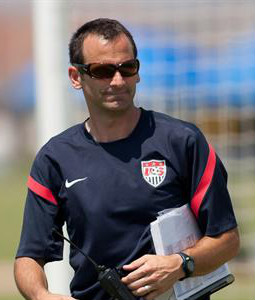
Lepore sees progress at Academy Playoffs
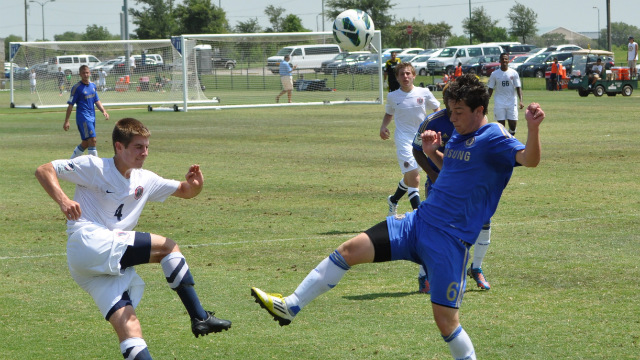
July 4, 2013


Last week’s Academy Playoffs represented the conclusion of the first-ever ten month Development Academy season for every club.
Its summer showpiece event, the Playoffs served a multi-faceted purpose in Frisco, Texas, as the U.S. Soccer Technical staff took advantage of having everyone in one place to continue learning how to improve player development.
“Whenever we can get all of our clubs together it’s such a great opportunity on so many levels,” Director of Scouting Tony Lepore told TopDrawerSoccer.com. “For scouting, for club evaluation, for coaching education that we did, for bringing together all our national staff with our scouts, we had 30 of our key scouts here, all of our national team staff here, except for [U14 BNT coach] Hugo [Perez], who is in Turkey. Those opportunities are always great. And for the clubs it’s part of more meaningful games.”
The biggest changes heading into the 2012-13 season was the adoption of a ten-month schedule nationwide. It caused waves in some corners, going up against the traditions of high school soccer, as players were technically no longer allowed to play both.
Given that this summer’s playoffs was the first of its kind off the heels of a ten-month season for everyone, the practice adapted was clearly visible in Frisco as Lepore noted that the system for player development is indeed progressing forward.
“We knew the benefits, so it’s nice for the clubs to feel that and for the players to feel those benefits now, because with more training players seem to have a more clear understanding of their roles and you know us, we’re always looking at style of play,” Lepore said. “We’re seeing more teams building out of the back and playing like our youth national teams, and that’s really important that we’re all on the same page. We’re seeing even more teams that are able to keep the ball longer.”
Part of making progress is listening to concerns of member clubs. Lepore noted that is something that what it isn’t always the easiest; it’s an important aspect of continuing to improve player development.
“It’s a tough process sometimes but we always want to be about being open to criticism and feedback,” he said. “We are going to push our clubs where we think they need to be pushed, but we recognize the things they are doing well, in many cases we reward them for things they do well. But we always came into the Academy, even ourselves, being open to criticism, and that’s still a really important part of it if we’re going to improve as a player, as clubs.”
Bringing all the clubs to Frisco is also an opportune time to compare notes with how teams looked during the year. With a comprehensive, nationwide network of Technical Advisors (nine in all, who work under Lepore), 1,100 games were scouted this year, and U.S. Soccer visits each club’s training session each month.
With all teams in one place, it gives scouts a chance to see teams they are familiar with cope with a style change against different opposition.
“It’s really good for a scout from Northern California to see one of their teams play against a team from New England, or from Chicago and see a team from the Southeast,” Lepore said.
Of course, one of the negative aspects about hosting the competition in North Texas at the end of June is the risk of heat. And for most of the week, temperatures flirted around triple digits, although it wasn’t nearly as bad as 2012.
Lepore thought there was even a positive to the conditions.
“It was good because it does force teams to play a style of play we need to improve upon, which is knowing how to slow the game down, control the pace of the game through possession and resting with the ball,” he said. “And not getting into these direct games and putting the ball down on the ground and playing which is really important to our style of play now, playing simple and putting the ball down. So that sort of forces that issue as well and it was much better than last year.”
The recent struggles of U.S. Men’s Youth National Team (the U17s failing to make the World Cup and the U20s not qualifying from their group in Turkey) weren’t a big concern either, as Lepore maintained a big picture approach.
“We need to always be careful at the youth level not to use results as a way to measure progress,” he said. “Is it discouraging [not to make a youth World Cup]? Of course. We know what the opportunities for a player we can get there. But really we’re looking at long term. This is all about long term, it’s how many players end up playing in qualifying for the first team, that’s the team that needs to win. Is it discouraging that our 20s didn’t go through? Of course, we want to win every game. That’s who we are. But we have to look at individual player development ahead of that, because it’s youth, and are we getting them ready for the next level. They’re part of a process, part of a pathway.”
The Academy isn’t resting on any of its successes and failures, however, as a new era with the introduction of a new age group is set to begin next season.
Part Two will run on Friday.
Headlines
- Recruiting Roundup: March 30-April 5
- 2026 Women's Division I Transfer Tracker
-
Midwest High School Roundup - Apr.

-
Commitments: Looking at Lafayette
- U19 WNT Roster for Argentina Trip
- TopDrawerSoccer TeamRank Update - Girls
- U23 WNT Roster Named for Spain Trip
-
Gen. adidas Cup: Knockout Goal-scorers
- TDS Boys Regional Rankings: Class of 2028
-
ECNL Girls PHX Spring U17 Standouts
Top 200/150 Club Player Rankings
