
U23s fall to Colombia 2-1, lose Olympics
March 29, 2016


The U.S. is not going to Brazil. In the end they were not all that close.
They were afforded hope after 90 minutes. They were given a buoyant life raft after 145. And after 170, the gig was up. Over two massively lopsided legs, the superior Colombians had cut off any hope for American escape, and the U.S. U23 team was left heaving on the floor, wondering where its ticket to the Rio Olympics had gone.
They needed only look to just the other side of the field. The Colombians had taken it through sheer force of action.
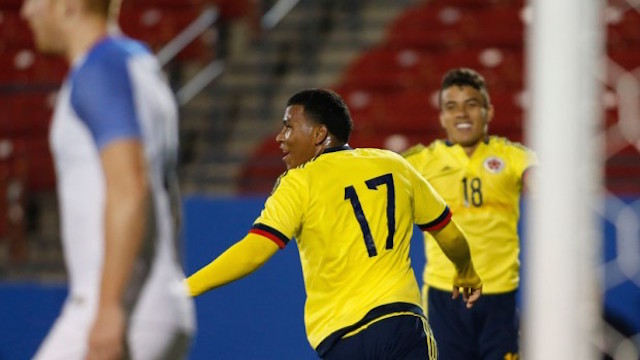
After a 1-1 draw in Colombia last week, the U.S. succumbed to a 2-1 loss in Frisco, Texas on Tuesday night in the second leg of their qualification playoff, dropping the U.S. aggregate to a definitive 3-2 on the series. The loss squashed their hopes of journeying to the Olympics, making it a second consecutive miss under U.S. technical director Jurgen Klinsmann.
Colombia took a deserved 1-0 lead in the first half, and the U.S. equalized after the restart on a flubbed back pass off a header that turned into a Colombia own goal. The Colombians drove in an eager dagger not long thereafter, and the U.S. was sent packing down 10 men after Luis Gil was issued a second yellow.
For the first time since the tournament was reorganized as a U23 event in 1992, the U.S. has missed back-to-back Olympic Games. Bleak times indeed. The fact that the final whistle chimed just hours after the senior team got its World Cup qualification bid back on track did little to change the gloom of the moment.
Here’s a look at three things we learned on Tuesday.
What worked in Colombia did not work in Frisco
In Colombia, the American midfield was set up to shield the back line, sweep away attacks and launch speculative counters at the comparatively soft tissue of the Colombian defense. It was successful because the U.S. essentially cashed in on its only real chance of the match, and Colombia’s finishing was among the worst ever seen in a competitive soccer game. It took the U.S. pulling down a Colombian player in the box to give Los Cafeteros their only goal despite a massive edge in every offensive metric in existence.
They were not so wanton on Tuesday.
Part of the issue’s genesis was in the midfield. Andi Herzog’s outfit stated in the pregame that part of its goal was to control a broader share of the match after being out-passed 3-to-1 in the first leg. But Colombia’s penchant to control the flow through an unusually deep Juan Fernando Quintero largely kept the midfield trio of Matt Polster, Emerson Hyndman and Wil Trapp from doing its job. Individually, all three were fairly good if unremarkable over the life of the series. Collectively, they were three unhooked train cars hurtling down the tracks at variable speeds.
In reality, the only two American players who distinguished themselves enough to remember were keeper Ethan Horvath and center back Tim Parker. And the Vancouver Whitecaps center back got away with a nasty leg-stomp in the second half Tuesday that should've earned him a red card. So it goes.
In lieu of Trapp pressing the attack on quick-break Gegenpress-style counters - the only goal the U.S. produced in this tie came in this way - they sagged back and marooned striker Jordan Morris on a lonely, shivering island. Morris was ineffectual all series, and the attack was anemic as ever. Which brings us to...
Herzog did not value width
As a rule, Colombia is among the widest nations on the planet. They play through their wingers at just about every level, and looking at Quintero’s pass map from Tuesday shows that the U23s are no different. They constantly looked to play into wider channels and funnel it in. That’s how its first goal of this game came, and the U.S. struggled to stop it.
Perhaps it was for that reason that Herzog attempted to funnel everything centrally to exploit space he must have assumed would be there. He started no true wingers in the first leg, and he only started one - Paul Arriola - in the second. Jerome Kiesewetter, who was bizarrely benched to start both games, came on at halftime on Tuesday, and Khiry Shelton didn’t make his first appearance until late.
Ultimately, the U.S. attack as a unit was pushed to the point of being nonexistent. In the span of 180 minutes, the U.S. managed one shot on target. And it was their only non-own goal of the series. Go figure.
Width could’ve helped. Even if Herzog didn’t want to play out of the back, Shelton or Kiesewetter (or both) would’ve been a welcome addition running under Trapp’s well-placed diagonals. As it was, Arriola too often drifted inside to find the ball because wide action wasn’t there. If he’d had a ballast on the other flank, Colombia’s fullbacks might’ve been pinned a bit further back. At the very least, it might’ve given the U.S. a chance to put a few more balls on frame and take Morris off his island.
The fullback play didn’t help. Eric Miller was anonymous in the opener, and Kellyn Acosta had a rough go on the left in this tie. The latter point made sense, since Acosta is a defensive midfielder on the club level. Miller was ultimately replaced by Desevio Payne, a ballyhooed youngster who plays for Groningen in the Netherlands. Payne was locked in a horror show all night, frequently abandoning his post and overlapping with center back Matt Miazga, who was shaky himself. You can pin the lion’s share of Colombia’s first goal on his shoulders. Somewhat fittingly, the first mistake came from the other flank - from Acosta.
This was not encouraging news for U.S. Soccer
The good news from Tuesday night came early in the evening, when the senior team all but ensured its passage to the final round of CONCACAF 2018 World Cup qualifying. The bad news was delivered in Frisco later on in the form of this game. Where U.S. Soccer goes from here is uncertain.
Before Tuesday the U.S. U23s had never failed to qualify for back-to-back Olympics, and the U.S. as a collective hadn’t missed consecutive Olympics since the 1968, when the tournament didn’t have age restriction. The fact that both Olympic misses came under Jurgen Klinsmann’s watch - and both Caleb Porter and now Herzog were his guys - will not sit well with just about anyone, let alone Klinsmann himself.
A reorganization is tricky at the U23 level, where most of the world’s teams are already 100 percent professional. That was pretty much the case for the U.S. as well, but it didn’t seem to matter. The Americans were woefully outplayed by Colombia after pulling in a distant third in CONCACAF late last year. Maybe the U.S. shouldn’t have had to beat Colombia to make the Olympics, but there’s little question they deserved to be in this position. And on balance they certainly didn’t deserve to be in Rio this summer.
Perhaps the scariest realization is that there isn’t much to be done, at least not in the immediate aftermath. Like a man who realizes a crime’s been perpetrated against him and the thief dissolved into the night without a word, the U.S. is boxing at shadows. The U23 age range is more of a reflection of the pool than a pipe into its underbelly. And the reflection on Tuesday was muddled, at best.
The U.S. has been dwelling on its failure in 2012 for four years now, and it now has four more years to stew on this one. While Mexico wins gold medals and sits atop its throne as the resident kings of CONCACAF, the U.S. is at home, wondering where it all went off the rails.
Headlines
- Recruiting Roundup: March 23-29
- 2026 Women's Division I Transfer Tracker
- Girls Academy Gen. adidas Cup Breakouts
-
Dallas Cup: Ten Girls to Watch

- TopDrawerSoccer TeamRank Update - Boys
-
Commitments: Swayed by Sam Houston
-
Generation adidas Cup: U16 Stars to Know
- TDS Girls Regional Rankings: Class of 2027
-
ECNL Girls PHX Spring U14s to Watch
-
Dallas Cup: 12 Boys to Watch
Top 200/150 Club Player Rankings
