
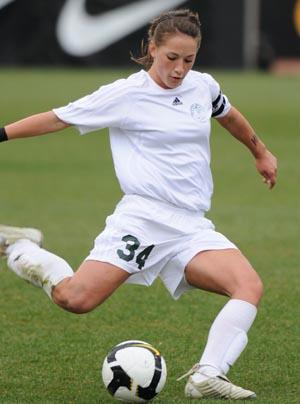
 Surprising the keeper but still delivering a quality ball takes lots of practice.
Why do Americans lack the driven ball?

March 12, 2009


Driving a ball toward a target is an area of play that can stand vast improvement in American soccer. Even at the highest levels, the number of crosses or long services that come floating in rather than being driven on a line is low, relative to what you see from top leagues around the world.
Surprising the keeper but still delivering a quality ball takes lots of practice.The physics lesson may not be necessary, but it bears repeating that a ball coming in on a straight line at high speed is much more likely to be headed on target in a manner that challenges the opposing goalkeeper, while a ball dropping in will require much more from the would-be finisher, and is also more easily dealt with by defenders and goalkeepers.
Madison 56ers Director of Coaching John Reddan has also noticed this, and we asked him for his thoughts and remedies on the situation.
“It doesn’t seem we have the same urgency to hit balls with pace,” he said. “How many times in EPL do you see own goals or goals that result from a cross hitting someone and they didn’t even know what they were going to do? It doesn’t take anything to turn that ball into the net.
“As far as why not, maybe we don’t spend enough time on it in our training,” he continued. “When we’re talking to our kids there are always a million things we’re trying to get across to our kids depending on their age group. It’s always first touch, speed of play, combination play, or as they get older, we’re talking about different formations, zonal defending or whatever. I guess some of these things sort of get left out of the mix. I can only speak for what I see, but even at my own club you might go to a game and see someone work it so well down the line before they shank it out of bounds, or maybe even the skill of keeping it in bounds sometimes is a challenge. It’s an area to improve.”
Reddan said indoor soccer in cold weather states may be an unintentional contributor to the lack of quality crossing.
“There’s no real call for the accurate longer ball. Kids have to be retrained in the spring for doing that,” he said. “In indoor you can dribble down the flank and be rewarded for smashing the ball forward for no other reason than that it will hit a wall and come back out. If you are outdoor you have to be able to change directions and hit it with pace. During the time they are playing indoor there’s a lack of repetition on that skill. That may be part of why there’s not enough urgency on it.”
Reddan mentioned some keys to effective delivery of the driven ball:
Reddan added that as with most technique, coaches can only introduce and drill the right methods. It is up to players to work on these things on their own.
“You want to have the player who says ‘Hey, I want to get better’ and then goes and does that on his own,” he said. “This skill is harder than most to replicate so you need either a large bag of balls, some people to help you recover the balls or a big wall.”
Surprising the keeper but still delivering a quality ball takes lots of practice.Madison 56ers Director of Coaching John Reddan has also noticed this, and we asked him for his thoughts and remedies on the situation.
“It doesn’t seem we have the same urgency to hit balls with pace,” he said. “How many times in EPL do you see own goals or goals that result from a cross hitting someone and they didn’t even know what they were going to do? It doesn’t take anything to turn that ball into the net.
“As far as why not, maybe we don’t spend enough time on it in our training,” he continued. “When we’re talking to our kids there are always a million things we’re trying to get across to our kids depending on their age group. It’s always first touch, speed of play, combination play, or as they get older, we’re talking about different formations, zonal defending or whatever. I guess some of these things sort of get left out of the mix. I can only speak for what I see, but even at my own club you might go to a game and see someone work it so well down the line before they shank it out of bounds, or maybe even the skill of keeping it in bounds sometimes is a challenge. It’s an area to improve.”
Reddan said indoor soccer in cold weather states may be an unintentional contributor to the lack of quality crossing.
“There’s no real call for the accurate longer ball. Kids have to be retrained in the spring for doing that,” he said. “In indoor you can dribble down the flank and be rewarded for smashing the ball forward for no other reason than that it will hit a wall and come back out. If you are outdoor you have to be able to change directions and hit it with pace. During the time they are playing indoor there’s a lack of repetition on that skill. That may be part of why there’s not enough urgency on it.”
Reddan mentioned some keys to effective delivery of the driven ball:
- Plant your foot around toward the middle of field.
- Bring your hips around properly so you are keeping it on the field first and foremost.
- Remember that if you are near the end line you need to pull the ball back some to keep it between the 6 and 12-yard lines where it’s more challenging for a goalkeeper to collect it.
- A proper cross hit on the run from the end line will likely result in the player falling out of bounds.
- Snap your knee on delivery in order to get proper velocity.
- While you need to turn your hips, you should be able to hit it without turning your hips around all the way so that you don’t lose the benefit of surprise. It’s good to keep the keeper guessing until the last moment.
- You can also keep them guessing by hitting the outside part of the ball, thus making it look more like a shot but as the ball screws away from the keeper, it becomes more of a cross.
Reddan added that as with most technique, coaches can only introduce and drill the right methods. It is up to players to work on these things on their own.
“You want to have the player who says ‘Hey, I want to get better’ and then goes and does that on his own,” he said. “This skill is harder than most to replicate so you need either a large bag of balls, some people to help you recover the balls or a big wall.”
Headlines
- Recruiting Roundup: January 5-11
- Professional Signing Tracker: 2025-26
- Tracking Division I Coaching Changes
- 2026 Women's Division I Transfer Tracker
-
Ten MLS Next AD U19 Players to Know

- Club Soccer Player Rankings: Boys 2029
-
Commitments: Sights Set on the Sun Belt
-
Ten MLS Next AD U17 Players to Know
- U18, U19, U20 MNT Training Camp Rosters
-
ECNL Boys FL: Top Under-16 Performances
Top 200/150 Club Player Rankings
