Washington's Era Changing National Title
March 25, 2026


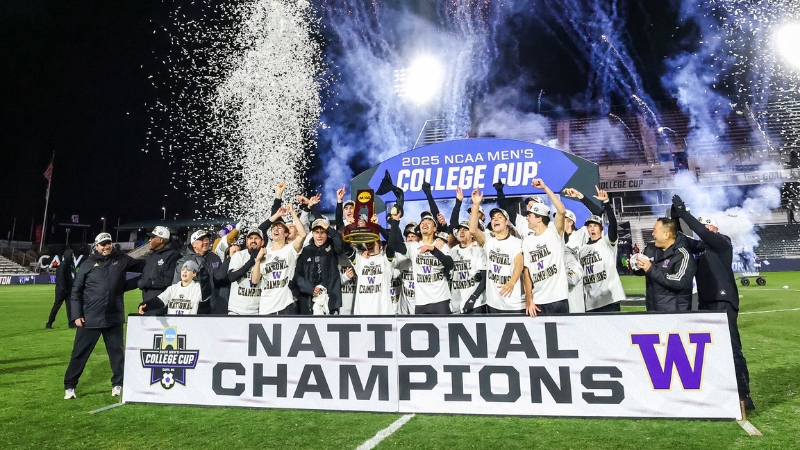
Division I men’s college soccer has evolved through different eras, and the latest, beginning in the 2010s, has undoubtedly been shaped by the rise in international athletes, from 18% of the player pool in 2010 to 35% by 2025. Furthermore, from 2020 to 2024, all five national titles were won by programs whose rosters were 21-42% international, in contrast to the prior 13 seasons, when each champion boasted a squad that was at least 80% domestic. Then, on December 15, 2025, Washington lifted the trophy, and not only did its entirely domestic roster counter that trend, but it did so in a way not seen for decades: a trophy born from players developed within the state.
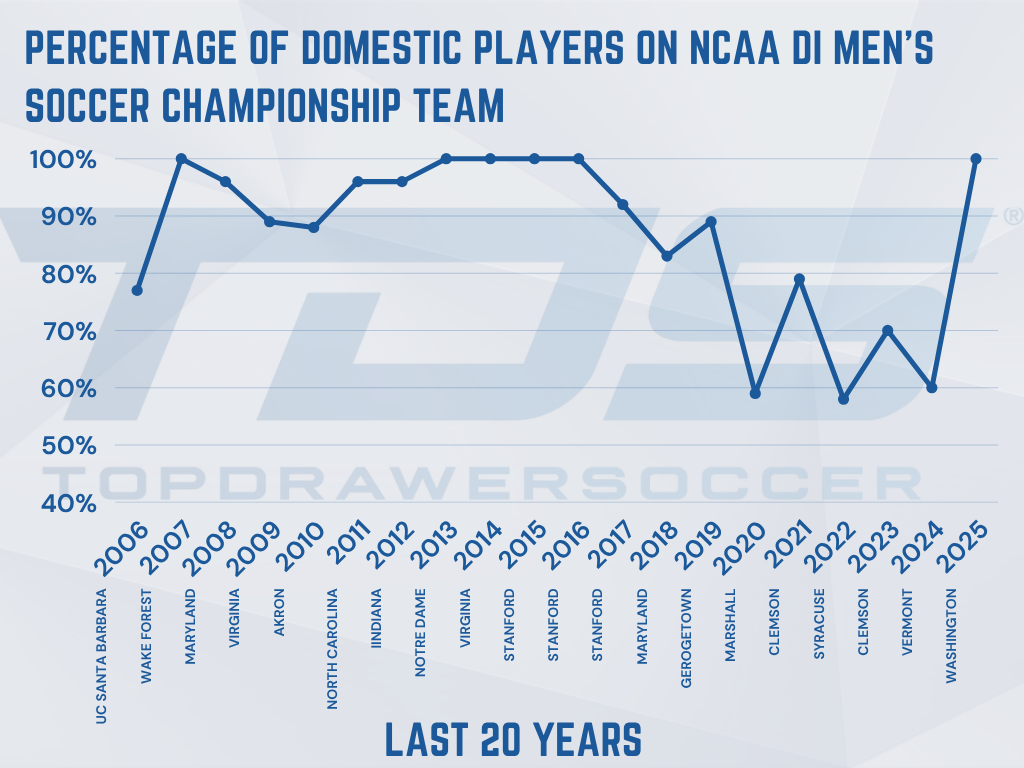
Domestic refers to athletes who played at least a year of youth soccer in the United States.
In the final triumph over NC State, seven of the eleven in the starting line-up hailed from Washington. The 20 in-state players on the 29-man roster set 21st-century records for an NCAA DI champion both in percentage and count. The previous closest was the 2001 North Carolina team, with 14 of 25 from the state.
Upon inspection, nothing about the Evergreen State seems likely to produce such an anomaly. After all, Washington is the 18th-most populous state in the U.S., and studies reveal that soccer is its third-most popular sport. To understand how the Huskies laid the foundations for that historic triumph, it is necessary to look back in time: rewind two decades and travel south, when head coach Jamie Clark was a relatively new assistant at a now-defunct program.
“My first assistant coaching job was at the University of New Mexico for Jeremy Fishbein. There was a really good group of guys that went to the national final and lost in the [2005] College Cup. That was almost all local kids who stayed with the program and got better . . . So I’ve seen it, I watched it. I’d seen local pride and getting to know your local guys. So I give a lot of credit to being part of Jeremy’s staff.”
Going even further back, Clark revealed to TDS that he picked up a core principle from the first coach he knew, his father, the legendary Bobby Clark, who himself led a national championship triumph with Notre Dame in 2013.
“In learning from my father, he was never chasing that one win . . . He just wanted to handle players well and treat them well, and that was it,” Clark told TDS while adding, “I mean, we are all competitive on game day, but we care more about the development of players and people. And the byproduct has always been success without worrying about it.”
That focus on development also naturally led the Huskies to search inward for talent.
“We have amazing club coaches [in Washington], we do. We have great clubs, and we tap into them all. We are community-based; we get out and do clinics and camps. But Washington isn’t some anomaly state,” Clark told TDS. “We get hit up with emails from across the country, and honestly, I tell a lot of kids every year that I think they look like great players, but I truly don’t know them well enough. And so with our local guys, they’ve been coming to camps and clinics. I’ve got an unbelievable picture of our 2013 team, and the ball boys standing with that team, three of them played on the team this year.”
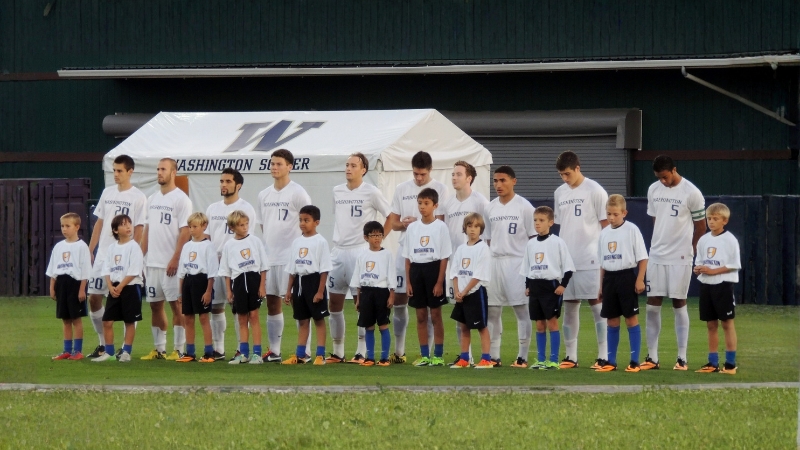 Nick O'Brien is third from the left. Fourth from the left is Connor Lofy. And furthest right is Chad Sovde.
And so the Washington mix was created, an approach revolving around recruiting locally, patience in player development, and placing the well-being of the student athlete above winning.
“I think more important to me, rather than the 20 of 29 being local guys, was that five of our starting eleven [in the national final] were red shirt guys. We believed they were going to be good. But they had to be patient. They had to stick with us in this day and age, where players want to jump ship. They had to appreciate Washington because if they didn’t, they would go elsewhere.”
The turnaround has been remarkable. Before Clark’s arrival in 2011, the Huskies had only one Sweet Sixteen appearance in 49 years and missed three straight tournaments. Now the program is a national powerhouse: five Elite Eight appearances, crowned with the 2025 title.
“I am happy and proud that our state is proud of us and that youth soccer is excited by us. I want all the American kids to think, man, I have a future in this game, and that I am not going to get overlooked.” Clark proclaimed before elaborating on the sport's overall growth. “I think the tide has risen for sure. Just at the general level, you used to be able to go to a field and just pick out the GOOD kid, and now everyone is pretty good. I think it’s hard to be special now because the overall level of youth soccer is very good.”
If judging by the Final Four, the Huskies may be ahead of their time, and college soccer is in for a new era that is a return to the old. While NC State fielded a roster that was 36% international, the remaining teams featured heavily domestic rosters in Saint Louis (90%), Furman (93%), and Washington (100%). That marked the first time since 2016 that at least three of the College Cup teams boasted rosters that were at least 90% domestic.
Still, this trend may be short-lived. Despite the Final Four's hint of change, international players have accounted for about 35% of college soccer rosters for most of the last decade, underscoring that recruiting foreign talent remains a mainstay for many programs.
Only time will reveal the wider impact of Washington’s championship on the sport. The Huskies, meanwhile, continue their tailor-made approach, landing a highly rated 2026 recruiting class with five of seven recruits hailing from the Evergreen State.
Headlines
- Recruiting Roundup: March 23-29
- 2026 Women's Division I Transfer Tracker
- Washington's Era Changing National Title
-
ECNL Girls PHX Spring U15s to Watch

- ECNL Girls Phoenix Selection Game Rosters
-
Commitments: California Stay
-
ECNL Girls PHX Spring U16s to Watch
-
2027 Boys Player Rankings Spotlight
- U17 WNT Qualifies for 2026 World Cup
- Club Soccer Player Rankings: Girls 2027
Top 200/150 Club Player Rankings
