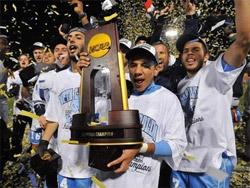
 2011 NCAA College Cup Champions, North Carolina Men's Soccer Team
Part 3 on the quality of American soccer
December 30, 2011


Part 3 of a 3-part series. Click to read Part 1 and Part 2
In this discussion about where we are as a soccer nation, I've emphasized the youth development side of things as that is the true key to long-term advancement and success on the international level.
A lot of fans focus on the results of the full national team, and may pay a little attention to the performance of youth national teams in the U17 and U20 World Cup events, but that is really an end product determined by a lot of other things that most casual observers don’t know or care much about.
2011 NCAA College Cup Champions, North Carolina Men's Soccer TeamToday I want to discuss the other historic weak link in our national setup, and one that is ultimately much trickier to fix than our youth development structure. I’m talking about college and professional soccer, both as separate parts and in view of their relationship.
For a soccer nation to be successful on the international level, it has to have a strong domestic league to provide opportunities for continued professional development and financial incentive for the playing pool of that country. We're moving toward 20 years of Major League Soccer in this country and it continues to provide that platform, albeit imperfectly.
Among areas in which the league can improve include coordinated scheduling with the international calendar, greater priority to signing and playing younger American players (particularly as opposed to filling rosters with marginal players from overseas because somebody with or working with the league is going to get some piece of a self-determined transfer fee) and a better scouting and signing policy to properly reward and value young players both before and after they turn professional. If the league does a better job in granting opportunities to young players, it can get on track with the rest of the world financially in terms of realizing the benefits of developing these top players professionally. Having our most promising players eventually being delivered to top-flight clubs in top-flight nations abroad is a good thing for the soccer nation, both internationally and domestically.
There is no need, however, for any of this to exist at cross purposes with college soccer. Longtime readers of the site may see this as a shift in my position on player development, and it may be, but I think slighter than you might believe. I've always been for what is best for players, as whole people. Now, it’s still true that our most surefire national team prospects will fall behind developmentally if they go to college soccer rather than immediately entering a professional system following their time in Academy (some should go pro even before their age group leaves Academy), but you have to remember we are talking about a fraction of a percentage compared to the overall national team and professional playing pool, which includes several hundred players at a time.
Remember that in a country like England, there are 92 professional clubs in the football league, all of which have youth teams. If every one of these at the U18 level has, say, 16 players, you are talking about approximately 1,400 players coming through the pipeline every two years. The sheer math of it tells you that well more than half of these players are not going to be signed as professionals, ever. That’s a very high rate of failure.
Contrast the plight of those players, most of whom have basically banked everything on making it since their early teens, with our young and aspiring players who have the chance to continue playing soccer competitively from ages 18-22 AND prepare themselves for future employment, including some who will still play professionally after school. If we can get to 100 good Academy programs (a number I suggested yesterday) and these each produce 10 playing prospects every two-year cycle, that’s 1,000 players.
Meanwhile if each of 20 MLS clubs was to sign 2 ½ 18-year olds every two years, that is only 50 players, just 5 percent of those good players coming through the Academy system. With what's left (and remembering that colleges recruit every year, not every two years), you easily get 16-deep rosters for 200 + DI men's college programs. That doesn't even include these schools recruiting internationally, which of course many do.
So what's lost to college is just a smattering of players. I understand that those programs who normally compete for national honors will lose out the most in terms of talent available, but their own hard work as recruiting coaches should ensure that they continue to secure the commitments of the best youth players in the country, even as a layer from the top move early to the pro game.
Professional soccer can give back to the college game with a greater commitment to signing American college players, and at a more competitive wage. With the home-grown signing policy now firmly in place, MLS could also agree to not sign/draft players once they've enrolled in school, until they've finished their junior competitive season.
Along these same lines, something should be worked out where MLS teams help underwrite a summer developmental league (similar to what exists for college baseball players) where more college players are competing regularly as well as getting good summer training, consistent with what they would see if they were already professionals at home or abroad. This would probably involve some flexibility from the NCAA as well, but this is much more likely to happen if the college coaches and pro organizations are committing to working together for the common good of American soccer.
Whatever the details, there are more than enough talented young players to go around between MLS and college soccer. The entities should be working together, because this too will help the soccer nation as a whole. The national team will still be, as it determines playing rosters under the setup I propose, selecting players who have played college soccer, even if it is more frequently for players 12-20 on a roster, rather than 1-11.
So this is a summary, a fairly brief overview, of areas where we can improve. I list them not to be negative, but to illustrate just how close we could actually be to reaching the top tier. I think all of the things I mention both in youth development and professional/college structure, are attainable. If we could do these things and stay committed over time to this path of player development, the sheer force of will that exists in this country’s soccer community, as well as that American attitude of wanting to win everything, could really see some brains attached to the brawn.
That would be the winning ticket for American soccer, and for realizing the dream so many of us have for it to be the best in all the world. That’s as good a New Year's wish as any I can think of.

Headlines
- Recruiting Roundup: May 11-17
- Game Changing Tool for the Transfer Portal
- How Do I Get Scouted by TopDrawerSoccer?
- Women's Division I May Transfer Tracker
-
2026 Women's CAA Breakout Candidates

- MESA Sponsors TDS Club Player Rankings
-
2026 CUSA Breakout Candidates
- Two-Semester Men's DI Season Heads to Vote
- U15 BNT Roster for Croatian Tournament
-
Men's Ivy League Breakout Candidates
Madrid Euro Soccer Academy
Top 200 Rankings
Top 200 Rankings