
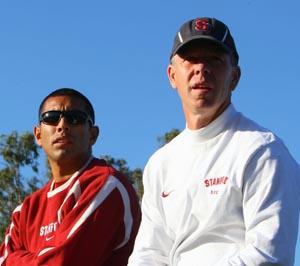
 Head Coach Brett Simon (right) and Associate Head Coach Robert Becerra.
Stanford coach doesn't rush the recruiting process

April 7, 2009


Stanford Men’s Soccer head coach Bret Simon is continuing to take a thoughtful approach to recruiting.
The veteran coach sees the continued trend toward early offers and commitments, but is firmly convinced that a thorough research of the recruiting class, including the close-up examination most possible at college camps, is the right approach toward building a winning program and helping prospective student-athletes make an informed choice.
“The trend toward early commitments is not a good thing. It’s not a good thing for athletes and families as a general statement,” Simon said. “There are some individuals who these things sometimes work out for. Maybe since they were two they knew wanted to go to a school and they always wear the colors, but for the majority of kids, it’s not a good situation.”
Head Coach Brett Simon (right) and Associate Head Coach Robert Becerra.That viewpoint established, Simon outlined his program’s approach to identifying the right prospects for Stanford.
“How we deal with that is to contact every coach at every major club across the country. We try to get the top sophomores and juniors and in some cases, freshmen. So that we can look at them with an educated eye,” he said. “We’re out virtually every weekend somewhere, because we recruit nationally. In my opinion you need probably three to five games to see players in enough different situations to properly evaluate them. Then we need to talk to their coaches and talk to school counselors. You have to have enough information to properly evaluate everyone, and even then there’s a little bit of guess work, so that’s why the quick evaluation and early offer is not a good trend. So we do a ton of research so we can know as best as possible what the player is all about as an athlete and person. That’s the game right now.”
Simon added that the trend of early commitments also makes it harder for coaches to project what their roster needs will be over the long term.
“When we were recruiting seniors, which wasn’t that long ago, you had a pretty good idea of who on your squad was graduating and what your players were like, but a lot of those things can change over two to three years,” Simon said. “I might have said, ‘I need a right defender next year,’ but maybe over time someone on your squad develops and fills that role, so maybe you didn’t need a right defender from a particular recruiting class. It’s already a difficult process. That’s why my opinion is people shouldn’t make the decision to go to college when they are a sophomore or a junior unless they are absolutely sure about all the reasons for going there outside of soccer.”
Simon said he tries to set up his program’s camp to serve the prospective student-athlete.
“We made the decision three or four years to transform how we do it,” he said. “We’ve put some elements in place to make it a little distinct. We bring college coaches in from other strong academic schools, whether DI or DIII, so there’s a little synergy between the schools as far as what we’re all about.
“Then, instead of the usual, we let them choose classes during the day, set up as functional training topics or by positions. Maybe it’s wing play or combining to get to goal, but we let them choose from a variety of sessions. Then they can play at night and be evaluated.
“It’s a good chance to be evaluated by different schools,” he added. “We find a lot of good players from across the country and a lot of good kids from overseas come in as well.”
For more information on the Stanford College ID and Development Camp for Boys, go to:
http://stanfordsoccer.com/index.php/boys-camp
The veteran coach sees the continued trend toward early offers and commitments, but is firmly convinced that a thorough research of the recruiting class, including the close-up examination most possible at college camps, is the right approach toward building a winning program and helping prospective student-athletes make an informed choice.
“The trend toward early commitments is not a good thing. It’s not a good thing for athletes and families as a general statement,” Simon said. “There are some individuals who these things sometimes work out for. Maybe since they were two they knew wanted to go to a school and they always wear the colors, but for the majority of kids, it’s not a good situation.”
Head Coach Brett Simon (right) and Associate Head Coach Robert Becerra.“How we deal with that is to contact every coach at every major club across the country. We try to get the top sophomores and juniors and in some cases, freshmen. So that we can look at them with an educated eye,” he said. “We’re out virtually every weekend somewhere, because we recruit nationally. In my opinion you need probably three to five games to see players in enough different situations to properly evaluate them. Then we need to talk to their coaches and talk to school counselors. You have to have enough information to properly evaluate everyone, and even then there’s a little bit of guess work, so that’s why the quick evaluation and early offer is not a good trend. So we do a ton of research so we can know as best as possible what the player is all about as an athlete and person. That’s the game right now.”
Simon added that the trend of early commitments also makes it harder for coaches to project what their roster needs will be over the long term.
“When we were recruiting seniors, which wasn’t that long ago, you had a pretty good idea of who on your squad was graduating and what your players were like, but a lot of those things can change over two to three years,” Simon said. “I might have said, ‘I need a right defender next year,’ but maybe over time someone on your squad develops and fills that role, so maybe you didn’t need a right defender from a particular recruiting class. It’s already a difficult process. That’s why my opinion is people shouldn’t make the decision to go to college when they are a sophomore or a junior unless they are absolutely sure about all the reasons for going there outside of soccer.”
Simon said he tries to set up his program’s camp to serve the prospective student-athlete.
“We made the decision three or four years to transform how we do it,” he said. “We’ve put some elements in place to make it a little distinct. We bring college coaches in from other strong academic schools, whether DI or DIII, so there’s a little synergy between the schools as far as what we’re all about.
“Then, instead of the usual, we let them choose classes during the day, set up as functional training topics or by positions. Maybe it’s wing play or combining to get to goal, but we let them choose from a variety of sessions. Then they can play at night and be evaluated.
“It’s a good chance to be evaluated by different schools,” he added. “We find a lot of good players from across the country and a lot of good kids from overseas come in as well.”
For more information on the Stanford College ID and Development Camp for Boys, go to:
http://stanfordsoccer.com/index.php/boys-camp
Headlines
- Recruiting Roundup: June 8-14
- TDS Launches Video Highlight Service
- How Do I Get Scouted by TopDrawerSoccer?
- Women's Division I May Transfer Tracker
-
Men's Summit League Breakout Candidates

- USMNT World Cup Squad Development: Part 1
-
Women's Summit League Breakouts
- MESA Academy Player Rankings: Boys 2027
-
Commitments: Heading East
-
Pacific NW High School Roundup - June
Madrid Euro Soccer Academy
Top 200 Rankings
Top 200 Rankings